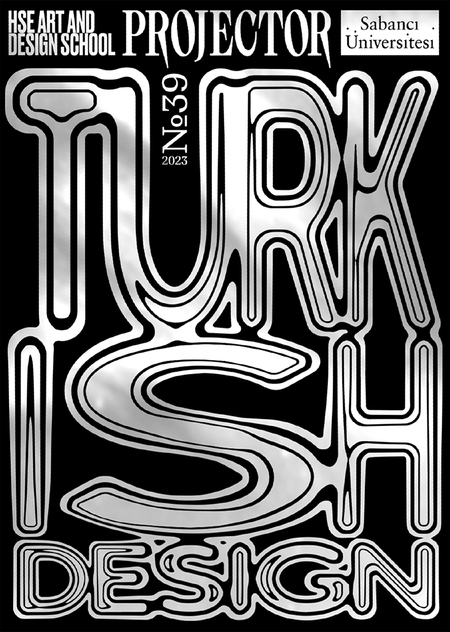
With this issue, dedicated to Turkish graphic design, the Projector celebrates the start of a new chapter in its history. From now, English will be the only language of the magazine. Our activities will primarily focus on the research of national design schools and their peculiarities.
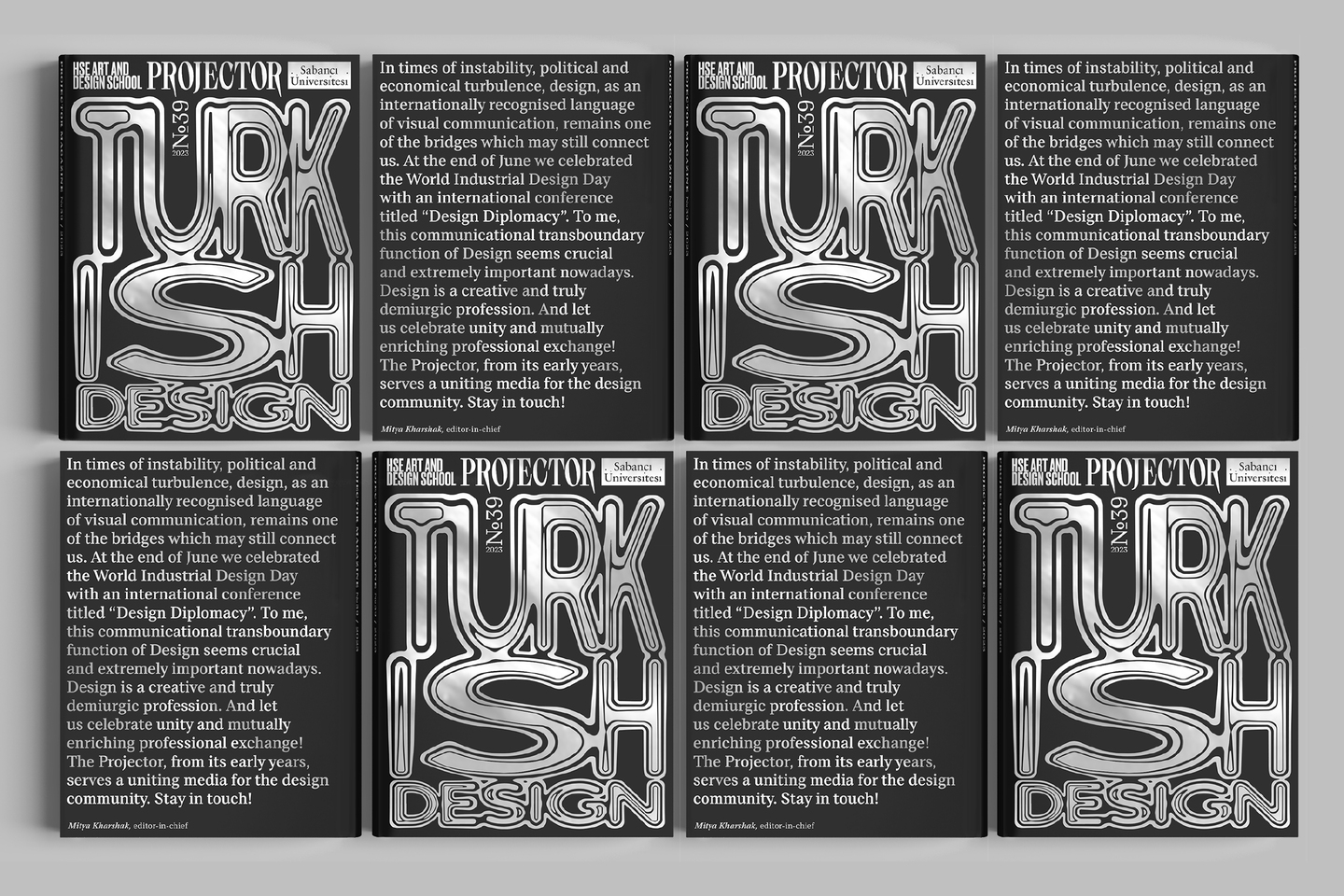
In times of instability, political and economical turbulence, design, as an internationally recognised language of visual communication, remains one of the bridges which may still connect us. At the end of June we celebrated the World Industrial Design Day with an international conference titled «Design Diplomacy». To me, this communicational transboundary function of Design seems crucial and extremely important nowadays. Design is a creative and truly demiurgic profession. And let us celebrate unity and mutually enriching professional exchange! The Projector, from its early years, serves a uniting media for the design community. Stay in touch!
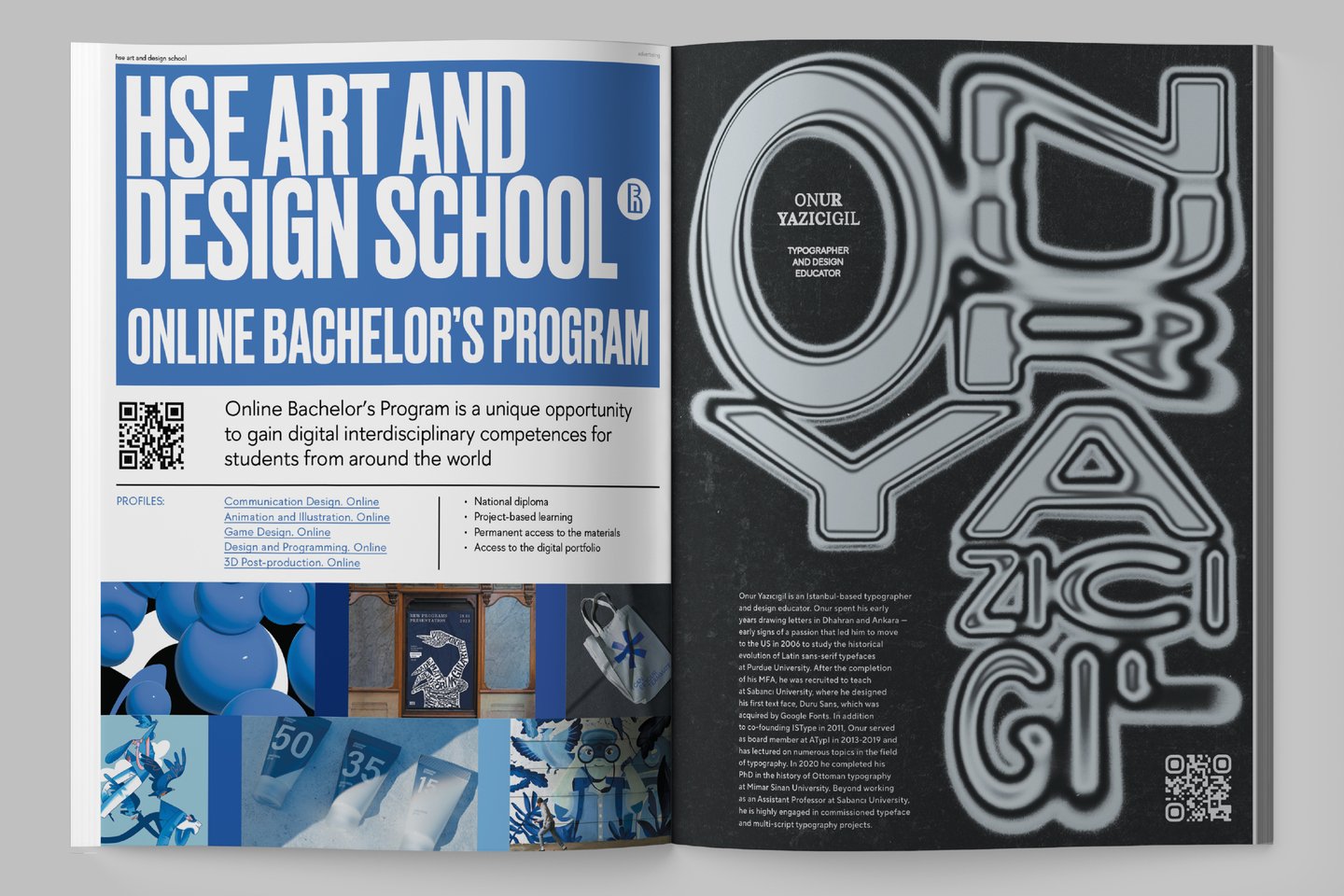
And we open this isuue with a publication by Onur Yazıcıgil, dedicated to the Turkish script reform: «Spoken language and written script are two defining characteristics that nations use in order to unify their citizens and to culturally distinguish themselves. This is applicable to both indigenous cultures and those who have yet to form notions such as „nation“. These indigenous cultures had not adopted any system of writing, but were long united through the unification of spoken language, which was very well enough to unite its inhabitants».
«The region of the Republic of Turkey, once having used the Arabic script, made a significant, and often deemed „over night, ” switch to the Latin alphabet in 1928. Yet, the seeds of this change can be clearly traced as far back as the 1860s. Not only did the eventual Script Reform bring a new visual mode to printed media, but also played a major role in the subsequent language reform, which resulted in the contemporary Turkish language“.
«Traditions of written scripts inevitably carry heavy baggage of information that denotes their geographic location and hence the group of people who created them. But this is also not peculiar for written scripts, as it is evident in any other cultural activity such as music, food and costumes. These cultural outputs help us „read“ the philosophical interpretaations of their creators».
One of the co-authors of this isssue — Selcuk Artut says: «When I graduated, the schools I attended did not do much to help me acquire the professional skills I would need. Instead, I preferred to prepare the soup according to my preferences. Today, you can advance yourself comprehensively by utilizing the resources that are easily accessible with a mouse click. Numerous online courses, webinars, and workshops can help you acquire the skills you need to succeed in your career. You can gain the knowledge and expertise necessary to excel in your field with dedication and hard work. As an example, I am currently teaching multiple courses on Interaction Design, among them the Physical Computing course relies entirely on my individual efforts to learn the content».
“ — Be patient; otherwise, designing something may turn out to be a never-ending process. — Design is not only about designing artifacts; they need to concentrate on designing their lives as well. — A decent designer needs to improve his/her skills and tastes by actively observing their field. — New technologies are arising, and a designer’s role is under considerable debate. A designer should be part of this conversation».
«I like having long walks alone to concentrate on developing ideas. Usually, seaside walks are the best to get a clear perspective on mingling with new things. Additionally, being in close proximity to nature and fresh air inspires my creativity. However, when it comes to the moment of creating things rather than thinking about them, I like to have comfort in my production environment. I usually prefer working in my art studio with no interruptions. This way, I can fully immerse myself in my work and focus on bringing my ideas to life. Nevertheless, I always make sure to take breaks and go for a walk outside to refresh my mind and gain new inspiration».
Safer Lehimler says: «The 21st century considers the interdisciplinary interaction as a necessity to the designer. This situation increases the need for collaboration and teamwork, which is valid for design processes. Design students and young designers should be engaged in teamwork as well as individual reading, writing and drawing. In this context, together with their teammates, they should define new design problems, diversify the visual experiments related to the abilities and discover new ways of seeing».
«Design is primarily emotional to me, but it is also conscious. Undertaking the task of delivering a determined message to the target audience, graphic products require a conscious action. However, this action essentially begins with an emotional and artistic transference».
«I have a hobby garden. I love dealing with the soil. At the same time, I enjoy watching the textures of formations and changes in nature. In particular, I associate the textures I see in nature with the design processes. I also love to travel, especially to study historical artifacts. I have a stamp collection since my childhood».
«I don’t think Turkish graphic design has distinctive features in the 21st century anymore. Although Turkish designers sometimes associate the rich cultural heritage with their products, we use the Latin alphabet as a communicative element instead of a language like Persian. I think this situation offers a universal perspective to design projects. Turkish designers, who constantly follow the innovations in the field of design and provide the audience with new visual experiences in this direction, carry out successful projects on an international scale and also take part in many international design events».
Umut Akkan says: «The biggest advice we get in our professional culture is to work for continuous improvement rather than being the best. Because there is always something better. That’s why I’m not the best at anything. I believe in continuous work and effort».
«I approach every job I am excited about with the same enthusiasm. Money is secondary. But this is not insignificant».
«It is necessary to work on many projects at the same time in the advertising agencies of our country. Every project has different time needs. While some projects are resolved quickly, some require much more time. Preferably, I would like to devote enough time to each project».